
In the video game Papers, Please the player is tasked with operating as an immigration border inspector for the fictional country of Arstotzka. The game play consists of approving or denying the immigrants based on increasingly difficult standards created by the Ministry of Admissions. The standards required of the immigrants to enter the country contributes to the idea that the Arstotzkan government is attempting to be a private utopia. The expectations of the potential entrants are impossible to uphold creating Arstotzka as a restricted area for the select few that qualify. However, through the perspective of the inspector character it’s seen that the quality of life is more in line with a dystopian society, where the player has to decide between surviving as the inspector or following their own morals.
In the span of a week in-game, the border opens to the public to then severely restrict those that can enter. On day one of the border being open, those entering only have to provide a valid Arstotzkan passport. By day seven, the “Basic Rules” section of the “Arstotzkan Ministry of Admission Rules and Regulations for Inspectors” handbook lists: “Entrant must have a passport. All documents must be current. Citizens must have an id card. Foreigners require an entry permit. Workers must have a work pass. No weapons or contraband. All Kolechians must be searched” (Day 7 Papers, Please). The Kolechians must be searched because the Ministry of Admission believed that Kolechian extremists were involved in a terrorist attack the previous day. While Kolechians are still permitted to enter at this point, the required search of all of them diminishes their individuality into an automatic perceived threat. The Arstotzkan government associated all Kolechians with the actions of one. This leads to complaints from Kolechian leaders, and the changing of the rules yet again. As the game progresses the rules continue to grow and change, complicating the job of the inspector, and further limiting the amount of people that can enter Arstotska. The inner workings of the government and society are not revealed, so all that is seen is that the government of Arstotzka has a preference on the type of people allowed in the country that the player is asked to uphold, regardless of morals.
Because of the lack of perspective on what the average Arstotzkan’s life is like, the player has to assume the best representation is of the inspector. With the job becoming more complicated, the speed of processing entrants slows, causing the amount of money made to diminish. As this happens, the player has to make decisions on what basic accommodations to purchase and which to neglect. If food or heat is unaffordable then the inspector’s family will get sick, creating the need for medicine: another expense. Unfortunately, if medicine cannot be purchased either, the family member will die.
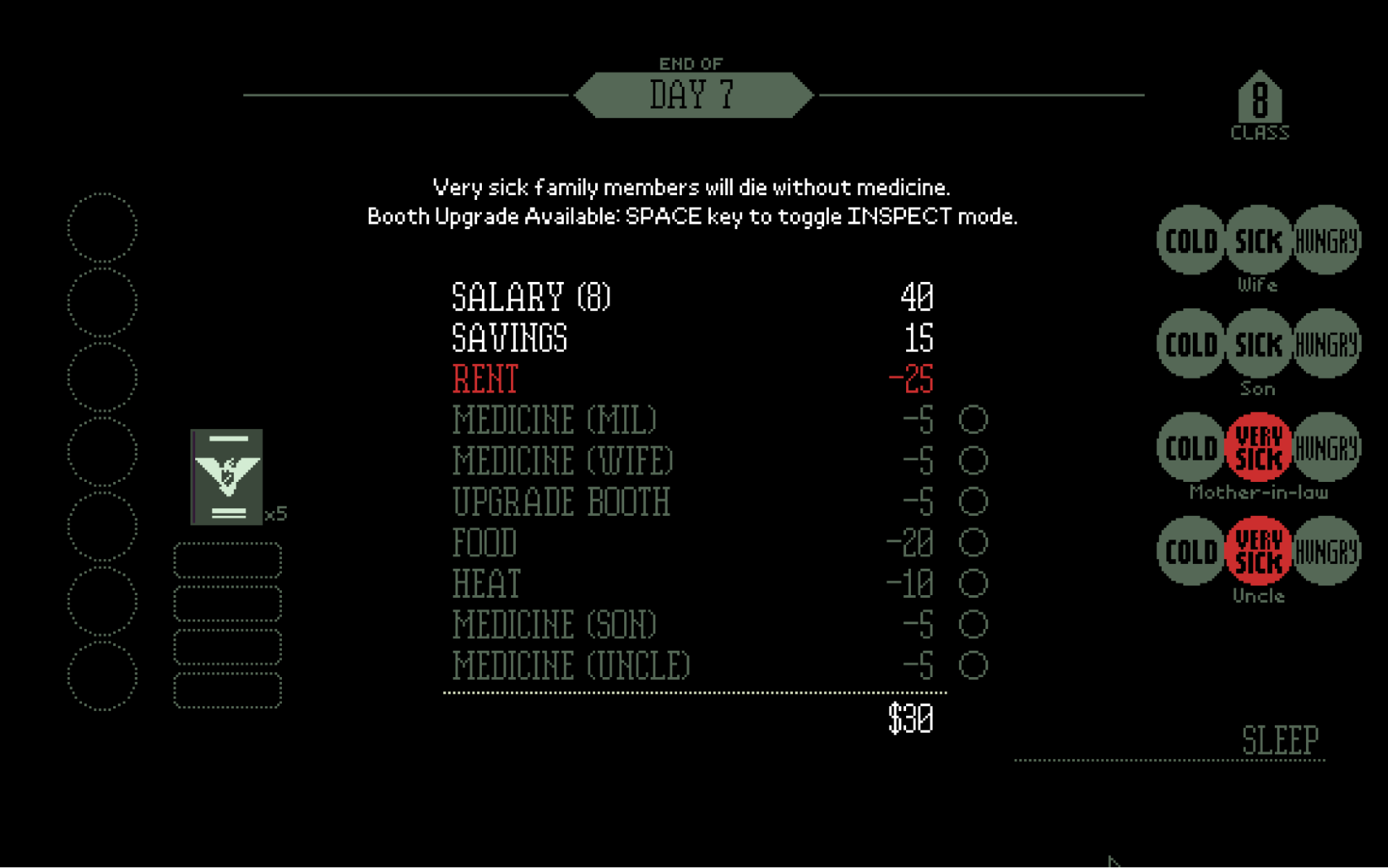
Shown in the image above, there are thirty spendable dollars, but fifty five dollars worth of expenses.This pressure leads to the temptation of accepting bribes. However, the inspector will still be issued a citation for bypassing a rule. Too many citations lead to a financial penalty that can counteract the bribe accepted. This requires a balancing of the player’s own morals to treat the entrants with grace while also attempting to maintain a living family.
One of the moral dilemmas the player is faced with is whether or not to help The Order of the Ezic Star, also called Ezic. Ezic asks the inspector to allow its agents through the border without proper documentation. This results in citations, however, Ezic provides a substantial bribe for cooperating. This bribe is taken away from the inspector after neighbors notice the increase of wealth, but continued support of Ezic is encouraged through the promise of a better government. According to the Papers, Please wiki, “depending on the degree of cooperation [with Ezic], different endings will occur” (https://papersplease.fandom.com/wiki/EZIC). The driving force of the game is how the player will react to Ezic. One of the endings is only achieved by being a perfect Arstotzkan and refusing to help Ezic. This is the only ending in which the game can continue, proving that the player’s lack of morals is the only way to survive in a dystopian society.